Getting everyone sat down
Three steps, and your mother is already playing
Create your room
Call it thanksgiving or sunday, choose the rules, and keep it for every game your group plays.
Invite your people
Send a private invitation. Membership, not a guessable URL, decides who can enter.
Play on phone or web
Sign in with the same account and your room, friends, and shared history follow you.
Nobody free tonight? Join Quick Play instead, and play with three other players; computer players fill any empty seats after one minute.

The point of the game
Two things to build, seven rounds to build them in
Every round has a contract — the combination you have to put down on the table before you can do anything else. Round one wants two sets. Round seven wants three runs. Get rid of all your cards and the round ends; everyone else counts what is still in their hand against them. The lowest score after seven rounds wins. Read the full rules.


Nobody has to ask
The table tells you when it is your turn
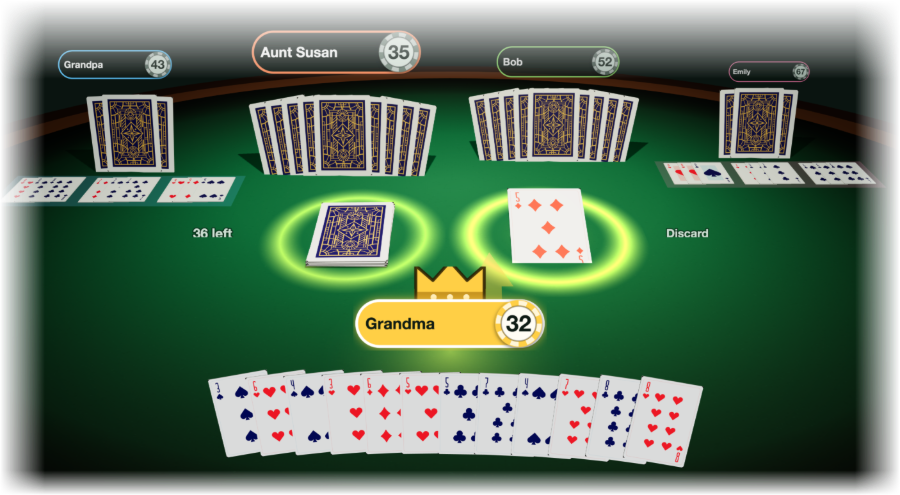
The seat lights up, and the pile you are allowed to take from is ringed in gold with an arrow pointing at it. Nobody has to say "whose go is it?" down a phone line, and nobody has to remember what this round wants — it is written on the screen the whole time.
Private rooms also keep the table together between games: the room history, standings, and head-to-head results remain there when everyone comes back.

Made for the whole family
Cards you can read at arm’s length
Half the people at a family table are over seventy and playing on a phone. So the deck is the ordinary red-and-blue one you have played with for forty years — but the number and suit in the corner are printed at twice the usual size.
- You can see the whole table. Everyone’s cards, both piles, everything laid down — from above, the way it looks when you are sitting there.
- Nobody is left behind. Drop off the wifi and come straight back to your seat and your hand.
- Nothing to buy, ever. No betting, no chips, no money in the game at all.

A small thing
Seven printed backs come with the game
A table is dealt from one of them. It is the sort of detail nobody asks for and everybody notices — the same way a real house has its own pack in the drawer.

Before you start
Questions people ask
- Is it free?
- Yes. There is no charge and no money in the game. Online multiplayer uses an account; solo practice does not.
- What is the difference between the two tables?
- Quick Play finds a four-seat match and fills gaps with computer players after one minute. A private room is a lasting members-only table with invitations, custom rules, and shared history.
- Can I play on my own against the computer?
- Yes. Solo practice starts immediately with computer players and does not require an account.
- How many people can play?
- Quick Play has four seats. Private rooms support two to eight seats.
- Do we need to download anything?
- No. It runs in the browser on a phone, a tablet or a computer.
- Is Shanghai the same as gin rummy?
- No — they are cousins. Here is the difference.
- What if my mother has never played a game online?
- She types her name and taps a card. There is a reminder of what the round wants on every screen, and the pile she may take from glows.
- What is it actually called?
- Shanghai, contract rummy, Liverpool rummy, progressive rummy — the same game, under whichever name your family uses.
Deal everyone in
Find a four-seat match, or create a lasting private room for your people.