The rules

How to play Shanghai

Shanghai — you may know it as contract rummy — is played over seven rounds. Each one names a contract you must lay down before you may play any other card. On your turn you draw one card and throw one away, and the first person to get rid of everything they hold ends the round. After seven rounds, the lowest total wins.

The middle of the table: the face-down pile on the left and the thrown-away five of diamonds on the right, both ringed in gold light because it is your turn to take a card from one of them.
A turn begins here: take the top of the face-down pile, or the card the last player threw away.

The shape of it

What a round looks like

Everybody is dealt a hand. On your turn you take one card and throw one away, going round and round, until somebody can lay down what this round asks for. Once you are down you can start emptying your hand onto the table — yours and everybody else’s combinations.

The moment one person is out of cards the round stops dead. Everybody else is left holding whatever they were holding, and it is counted against them.

The Shanghai table seen from above: four other players across the green felt with their names and scores on coloured plates, the face-down pile and the discard pile ringed in gold in the middle, and your own hand of cards fanned out along the bottom.
Round four, mid-hand. Three players have laid combinations down in front of them, the scores so far are on the name plates, and Grandma is to play.

Rule one

There are only two things you can build

A set laid face up on the green felt: the nine of hearts, the nine of clubs and the nine of spades side by side under the table lamp.
A set: three or more of the same number. Suits do not matter — this is the nine of hearts, the nine of clubs and the nine of spades.
A run laid face up on the green felt: the five, six, seven and eight of diamonds in order, all of the same suit.
A run: four or more in sequence, all of one suit — the five, six, seven and eight of diamonds. The ace is low, so A-2-3-4 is a run and Q-K-A is not.

Rule two

The seven contracts

This is the whole game on one card. You cannot put a single thing on the table until you can put the entire contract down at once — until then you draw, you throw, and you wait.

Each round asks for something harder than the last, and deals you more cards to do it with.
RoundYou must lay downCards dealt
12 sets11
21 set + 1 run11
32 runs11
43 sets11
52 sets + 1 run11
61 set + 2 runs11
73 runs — go out without a discard11

Rule three

A turn is three moves, in this order
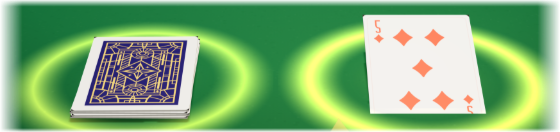
  1. The middle of the table: the face-down pile on the left and the thrown-away five of diamonds on the right, both ringed in gold light because it is your turn to take a card from one of them.
    Take a card. Either the top of the face-down pile, or the one the last player threw away.
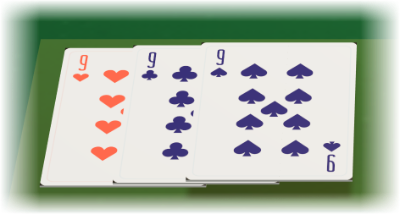
  2. A set laid face up on the green felt: the nine of hearts, the nine of clubs and the nine of spades side by side under the table lamp.
    Lay down, if you can. Only the whole contract, and only in one go. After that you may add single cards to anything on the table.
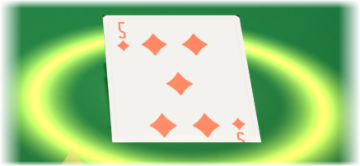
  3. The discard pile: the five of diamonds lying face up on the felt inside a ring of gold light, tipped toward the camera so its number can be read from your seat.
    Throw one away. Every ordinary turn ends with a discard. In round seven, laying down all twelve cards after your draw ends the game without one.

Rule four

Buying the card somebody threw away

This is the part that makes Shanghai Shanghai. When somebody throws a card away you can ask to buy it — even when it is not your turn. If more than one person wants it, the person closest to playing next gets it.

Buying costs you the card you wanted plus one extra card off the pile, so your hand grows by two. You get three buys each round, which makes spending one a real decision rather than a reflex.

Your own twelve cards held up toward you in a fan, close enough to read: the ordinary red-and-blue deck, each card carrying an oversized number and suit in its top corner.
Twelve cards in hand. Every card you buy is one more you have to get rid of before the round ends.

Rule five

Jokers stand in for anything

A joker can be any card you need. Two rules keep them honest: a combination can never contain more than one joker and must have at least two natural cards. A joker left in your hand at the end of a round is worth 25 penalty points.

They are powerful and they are dangerous, and holding one while somebody else looks ready to go out is one of the more uncomfortable feelings in the game.

A joker card held at the right-hand end of your fan.
A joker at the end of your fan. Useful right up until the moment the round ends.

Rule six

Counting up, and why low is good

When somebody goes out, everybody else adds up the cards still in their hand. Those points are against you.

  • Ace 15 points
  • Two 20 points
  • Three to nine 5 points
  • Jack, queen, king 10 points
  • Joker 25 points

This catches people out on their first night: the person at the top of the scoreboard is the one with the fewest points, not the most.

Four cards at the right-hand end of your fan, close up: the four of spades, the seven of hearts, the eight of clubs and the eight of hearts, each with its number and suit printed oversized in the top corner.
Four number cards left at the end of a round — twenty points against you under the standard rules.

Now play a hand

The rules make far more sense with cards in front of you. Sit down with whoever is around, or make a table and send the link round.